
- Conferbot lets energy and utility companies deploy AI chatbots across 8+ channels including WhatsApp, Messenger, Instagram, and your website -- all from one no-code visual builder with 30+ node types.
- Automate billing FAQs with an AI-powered knowledge base using leading AI, Claude, or Gemini. Handle account inquiries, payment questions, and rate explanations instantly without burdening call center staff.
- Streamline outage reporting with location data collection and file upload nodes. Customers can submit outage details, attach photos, and receive status updates directly through the chatbot on any channel.
- The AI-powered response engine handles thousands of concurrent customer conversations, providing accurate answers to service inquiries while seamlessly handing off complex cases to live agents with full context.
- Connect to your existing utility systems via Zapier (5,000+ apps) and custom webhooks for billing platforms, CRM tools, outage management systems, and payment portals.
Why Utility Companies Choose Conferbot
Electric utilities, gas companies, water providers, and solar installers worldwide trust Conferbot to reduce call center volume, improve customer satisfaction, and deliver instant service across every channel.
Connect with Your Utility Stack
Link your chatbot to the tools your utility company already uses. Connect billing systems, outage management platforms, and payment portals through webhooks and tap into thousands of apps via Zapier.
Everything You Need for Energy Automation
Purpose-built tools that help energy and utility companies automate customer service and streamline operations across billing, outages, and service management.
Billing FAQ Bot
Build a knowledge base with your billing documentation and let leading AI, Claude, or Gemini generate accurate, context-aware answers to customer questions about rates, charges, payment plans, and account details.
Outage Reporting Bot
Enable customers to report outages with precise location data using the geolocation node and attach photos of damage via file uploads. Route reports automatically to your outage management system using webhooks.
Service Request Bot
Use the no-code visual builder with 30+ node types to create service flows for starting, stopping, and transferring utility accounts. Condition logic routes customers through the right path based on their request type.
Payment Support
Connect to your payment portal via webhooks so customers can check balances, view payment history, and get directed to pay their bills. Automate payment plan enrollment and overdue balance notifications.
Energy Tips Bot
Use AI article generation to create and deliver personalized energy-saving tips, seasonal efficiency advice, and program information. Help customers reduce consumption while building brand loyalty and trust.
Analytics Dashboard
Monitor chatbot performance across 6 comprehensive dashboard views. Track conversation volumes, popular inquiry topics, resolution rates, channel usage, and customer satisfaction to continuously optimize your support.
Powered by leading AI models including GPT-4, Claude, and Gemini.
Get Started in Three Easy Steps
Deploy your chatbot in minutes, not months. No coding required.
Choose Your Template
Select from pre-built utility chatbot templates for billing support, outage reporting, service requests, or payment assistance -- or build from scratch with 30+ drag-and-drop node types.
Customize & Connect
Personalize responses, import your billing documentation and service policies into the knowledge base, connect payment and outage systems via webhooks, and enable AI models like leading AI, Claude, or Gemini.
Deploy & Monitor
Launch on your website, WhatsApp, Messenger, and 5 more channels. Track customer interactions with real-time analytics across 6 dashboard views and optimize your chatbot as you go.
Trusted by Energy Organizations Everywhere
From regional cooperatives to large-scale utility providers, energy companies use Conferbot to deliver better customer experiences and reduce operational costs.
Why Energy and Utility Companies Need AI Chatbots
Energy and utility companies face a customer service paradox: they serve millions of customers, yet the vast majority of interactions involve a narrow set of highly repetitive requests. Industry data shows that utilities receive 60% of all inbound calls about billing -- questions about current balances, billing dates, usage charges, and payment arrangements that follow predictable patterns and require no human judgment to resolve. Despite this, these routine contacts tie up enormous call center capacity at significant cost.
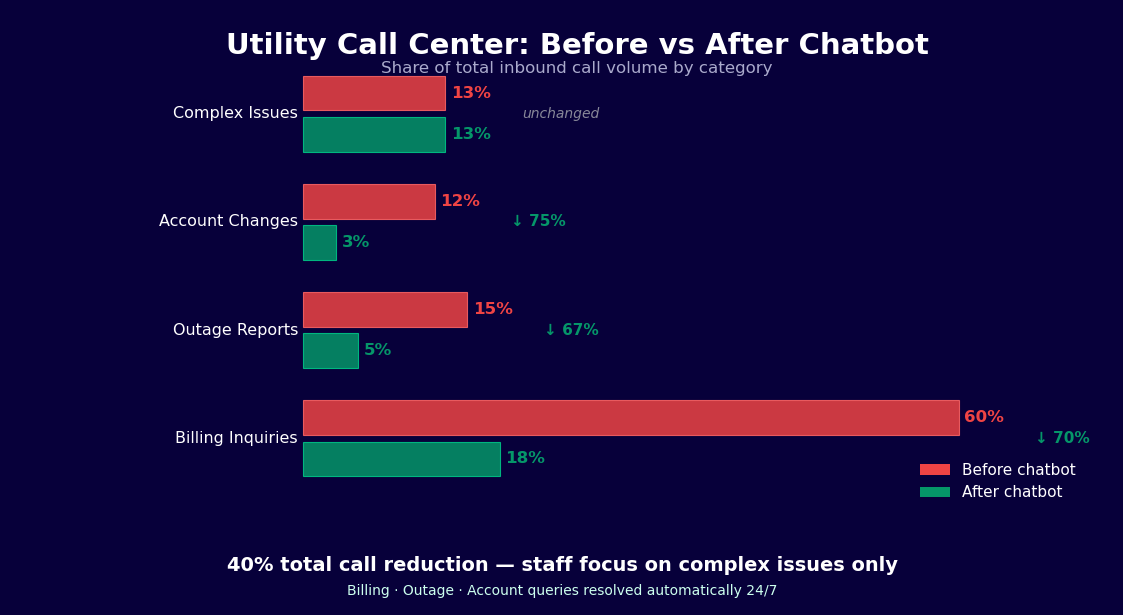
An energy and utility chatbot resolves this paradox by handling routine customer contacts automatically across your website, WhatsApp, and other digital channels. It answers billing questions, accepts meter readings, reports and tracks outages, processes move-in and move-out requests, presents plan options, and enrolls customers in renewable programs -- without a single call center agent involved. Utilities that deploy AI chatbots report call center volume reductions of up to 40%, with some reporting higher deflection for billing-specific contacts.
Beyond cost reduction, chatbots address the fundamental expectation gap in utility customer service. Customers expect immediate answers, but utility call centers struggle with peak-demand periods: after major storms, during billing cycle windows, and at month-end. A chatbot absorbs these demand spikes without queue buildup, providing consistent service quality regardless of contact volume.
Conferbot's AI chatbot builder lets utility customer service teams deploy intelligent bots connected to their billing systems and outage management platforms via API integration. With analytics tracking deflection rates, resolution rates, and customer satisfaction, utilities gain continuous visibility into chatbot performance and ROI.
This guide covers the highest-impact chatbot use cases for energy and utility providers in 2026: billing automation, outage management, meter reading, energy efficiency, plan comparison, move processing, payment arrangements, and renewable enrollment.
Billing Inquiry Automation and Payment Processing
Billing is the dominant driver of utility call center volume. Automating billing inquiries is therefore the highest-ROI starting point for any utility chatbot deployment.
Instant Balance and Bill Explanation
The most common billing inquiry is also the simplest: "What is my current balance?" or "Why is my bill higher this month?" A chatbot connected to your billing system via API integration answers these questions in seconds. For "why is my bill higher" inquiries, the bot provides a clear breakdown: usage variance compared to the prior period, any rate changes, applicable fees, and relevant weather data if seasonal usage patterns are a factor. This transparent explanation resolves the inquiry without escalation in the vast majority of cases.
Payment Initiation and Confirmation
Beyond answering questions, the chatbot enables customers to make payments directly within the conversation. The bot confirms the amount due, presents available payment methods (bank transfer, credit card, auto-pay enrollment), processes the transaction via your payment gateway integration, and provides an instant confirmation with a reference number. Customers who can pay through their preferred channel -- including WhatsApp at any hour -- are more likely to pay on time, reducing overdue account volume.
Billing History and Usage Analysis
Customers who want to understand their usage trends or compare current charges to historical bills receive instant access through the chatbot. The bot retrieves 12-24 months of billing history, presents usage charts in plain language ("Your usage was 23% higher this December than last December, likely due to lower average temperatures"), and highlights any anomalies that might indicate an appliance issue or a meter problem warranting investigation.
Auto-Pay and Paperless Enrollment
Auto-pay and paperless billing reduce utility operational costs significantly. The chatbot proactively offers enrollment during billing conversations -- "Would you like to set up automatic payments so you never miss a due date?" -- and completes the enrollment within the same conversation. Utilities report meaningful increases in auto-pay and paperless enrollment rates when driven through conversational chatbot flows versus static web pages.
Outage Reporting and Real-Time Status Updates
Power outages and service disruptions generate enormous contact volume spikes at precisely the moments when call centers are least able to absorb them. A chatbot handles outage reporting and status updates at scale, eliminating hold queues during the most stressful customer service moments.
Instant Outage Reporting
When a customer reports an outage through the chatbot, the bot collects precise location information (service address confirmed from the account), describes the outage scope the customer observes, and submits a structured outage report to your outage management system (OMS) via API. The customer receives an immediate acknowledgment with a ticket number and estimated response timeline. This structured intake is faster and more complete than phone-based reporting, and the customer avoids hold times entirely.
Outage Status Self-Service
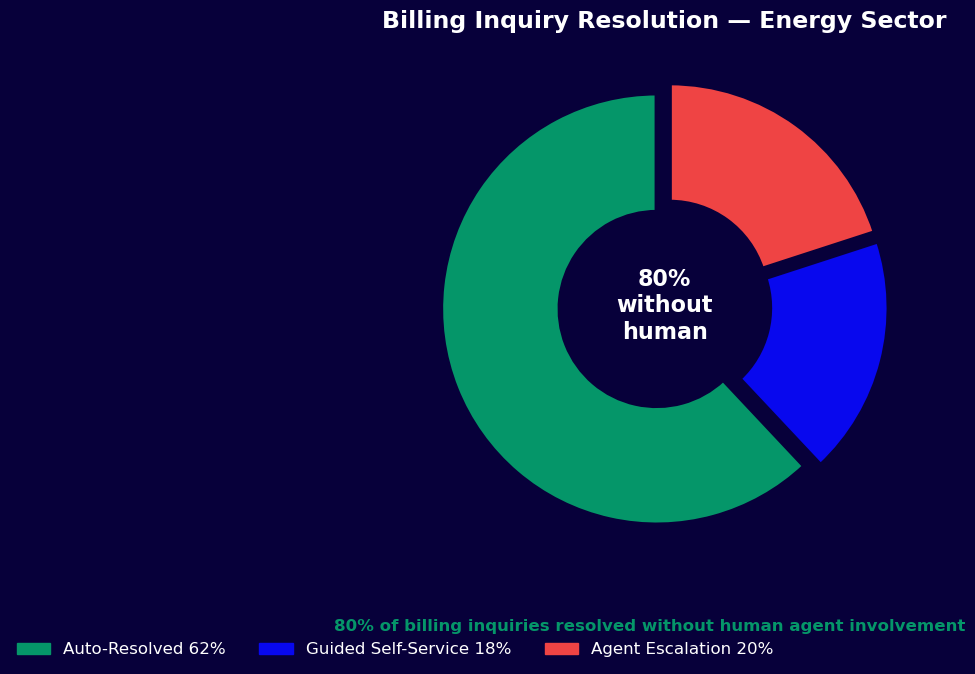
The second most common outage-related contact is a status update: "Is there still an outage in my area?" or "When will my power be restored?" The chatbot queries your OMS for the current outage status and estimated restoration time (ERT) associated with the customer's service address and delivers an instant, accurate response. This self-service capability alone deflects 50-70% of outage-related contacts during major events, preventing the call center from becoming overwhelmed when customers need information most.
Proactive Outage Notifications
Rather than waiting for customers to contact you during an outage, the chatbot proactively pushes notifications to affected customers through their registered channel -- website, WhatsApp, or SMS. Notifications cover outage detection, estimated restoration time, restoration progress updates, and final restoration confirmation. Proactive communication during outages dramatically reduces inbound contact volume and improves customer satisfaction scores, as customers feel informed rather than ignored.
Planned Outage Advance Notice
Scheduled maintenance outages are far less disruptive when customers receive advance notice with precise timing. The chatbot delivers planned outage notifications 24-72 hours in advance, provides preparedness tips for sensitive equipment, and offers customers the ability to report any concerns about the timing via a simple reply. This proactive approach converts a potential complaint driver into a demonstration of operational transparency.
Meter Reading Submission and Energy Efficiency
Two utility functions that create ongoing customer touchpoints -- meter reading and energy efficiency guidance -- are both well-suited to chatbot automation that reduces cost while improving customer engagement.
Self-Serve Meter Reading Submission
For utilities relying on customer-reported meter readings, the submission process has traditionally involved calling a hotline or using a web form. A chatbot simplifies this to a quick conversation: the bot confirms the customer's account and meter number, requests the current reading, validates that the submitted value is within a plausible range based on historical usage (flagging anomalies for review), and confirms receipt. Photo-based meter reading -- where the customer submits a photo and the bot extracts the reading using image recognition -- further reduces errors.
Chatbot meter reading submission typically achieves on-time reading rates 15-25% higher than traditional web form submissions, as the conversational prompt reduces abandonment and the validation step catches common errors before they create billing problems.
Energy Efficiency Recommendations
Customers with high usage bills are a natural audience for energy efficiency guidance. When a billing inquiry reveals higher-than-average usage, the chatbot proactively offers efficiency recommendations: insulation improvements, appliance upgrade suggestions, HVAC optimization, and smart thermostat benefits. These recommendations can reference the customer's specific usage profile, making them feel personalized and relevant rather than generic.
Utilities with energy efficiency programs use the chatbot to enroll interested customers directly. A customer asking "why is my bill so high?" can transition within the same conversation to enrolling in a free home energy audit program, requesting efficiency rebates, or connecting with an energy advisor via live chat. This inbound efficiency engagement converts at significantly higher rates than outbound marketing campaigns.
Smart Home and Demand Response Programs
For utilities offering demand response programs or smart home device partnerships, the chatbot serves as an enrollment and education channel. It explains peak-demand pricing, describes the benefits of smart thermostats or water heaters, and walks customers through enrollment steps. Demand response participation reduces grid stress during peak periods and often qualifies customers for bill credits -- a tangible benefit the chatbot can quantify and present conversationally.
Plan Comparison and Move-In/Move-Out Processing
Two of the most complex utility service interactions -- plan selection and residential moves -- involve multi-step processes that customers find confusing and that generate disproportionate contact center load. Chatbots handle both with structured conversational flows that guide customers to completion without human intervention.
Conversational Plan Comparison
Energy markets with retail competition require customers to choose between rate plans -- fixed, variable, time-of-use, green energy -- and most customers lack the information to make a confident choice. A chatbot simplifies this by asking a few qualifying questions: typical monthly usage, whether they are home during peak hours, tolerance for bill variability, and whether renewable sourcing is a priority. Based on the responses, the bot presents a ranked comparison of available plans with plain-language explanations of the trade-offs and estimated bill impact for each option.
This guided comparison approach increases plan enrollment rates by making the decision manageable. Customers who understand why a plan fits their situation are also less likely to churn when variable rates fluctuate, reducing costly plan-switching contact volume.
Move-In Service Initiation
New customers moving into a service area are high-value contacts who need a smooth onboarding experience. The chatbot handles move-in requests conversationally: service address, desired start date, account holder information, identification, and payment setup. It validates the address against your service territory, confirms start date availability, creates the account, and sends a confirmation with the account number, first bill date, and customer service contact. A complete move-in processed in under five minutes -- without a single phone call -- creates an immediate positive impression of the utility.
Move-Out and Transfer Processing
Move-out requests have historically required a phone call to ensure final meter readings, billing address updates, and deposit returns are handled correctly. A chatbot manages this entire process: confirms the service address and last day of service, collects the forwarding address for the final bill, schedules a final meter read if required, and provides a timeline for deposit return. For customers transferring service to a new address within the same territory, the bot handles both the move-out and move-in in a single conversation, making what was a two-call process into a single, seamless interaction.
Payment Arrangement Setup and Renewable Energy Enrollment
Two utility service areas with strong chatbot potential -- payment assistance and renewable program enrollment -- share a common characteristic: they involve multi-step processes where customer dropout is high but completion is in the utility's interest.
Payment Arrangement Automation
Customers who cannot pay their full balance in a single payment have historically required a call to a collections-trained agent to negotiate a payment plan. This creates barriers that often result in the customer avoiding contact until disconnection is imminent. A chatbot removes this barrier by making payment arrangements accessible and non-threatening at any hour.
The bot confirms the overdue balance, explains available arrangement options based on the account's history and program eligibility, presents a structured payment schedule, and confirms the arrangement with written terms. Customers who set up payment arrangements through the chatbot adhere to their schedules at rates comparable to agent-arranged plans, while the utility saves agent time for genuinely complex financial hardship cases. Automatic reminders as each installment date approaches further improve adherence.
Hardship Program Eligibility Screening
Utility assistance programs -- LIHEAP, low-income discounts, medical baseline rates -- are underutilized because eligible customers do not know they exist or find the application process daunting. A chatbot proactively screens customers with payment difficulty for program eligibility through a conversational intake, explains the benefits of each applicable program, and guides the customer through the application process. This proactive assistance reduces bad debt, improves customer loyalty, and fulfills utility social responsibility commitments.
Renewable Energy Program Enrollment
Green energy programs -- renewable energy certificates, community solar subscriptions, green tariffs -- represent growing revenue and customer retention opportunities for utilities. However, customers often find these programs confusing and enrollment rates remain lower than utilities would like. A chatbot explains renewable programs in plain language, uses the customer's actual usage data to calculate the estimated cost and environmental impact of enrollment, and processes the enrollment within the same conversation.
Customers who enroll in green energy programs through a personalized, data-driven chatbot conversation report higher program satisfaction and lower churn rates than those who enroll through static web pages, because the chatbot answers their specific questions and quantifies the personal impact of their participation.
ROI and Operational Impact
The financial case for utility chatbots is anchored in call center cost reduction and the operational savings from automating high-volume, low-complexity contacts. Here are the metrics utilities consistently achieve.
Call Center Volume Reduction
A typical utility call center handles hundreds of thousands of inbound contacts annually, with an average cost of $6-12 per call. Billing inquiries, the single largest contact category, can be deflected to chatbot self-service at high rates. A utility handling 500,000 calls annually at $9 average cost that deflects 40% of contacts saves approximately $1.8 million per year in call center operations alone. This does not include the secondary savings from shorter handle times for the calls that do reach agents, as chatbot-resolved first-tier contacts leave agents to handle only genuinely complex cases.
Outage Contact Deflection
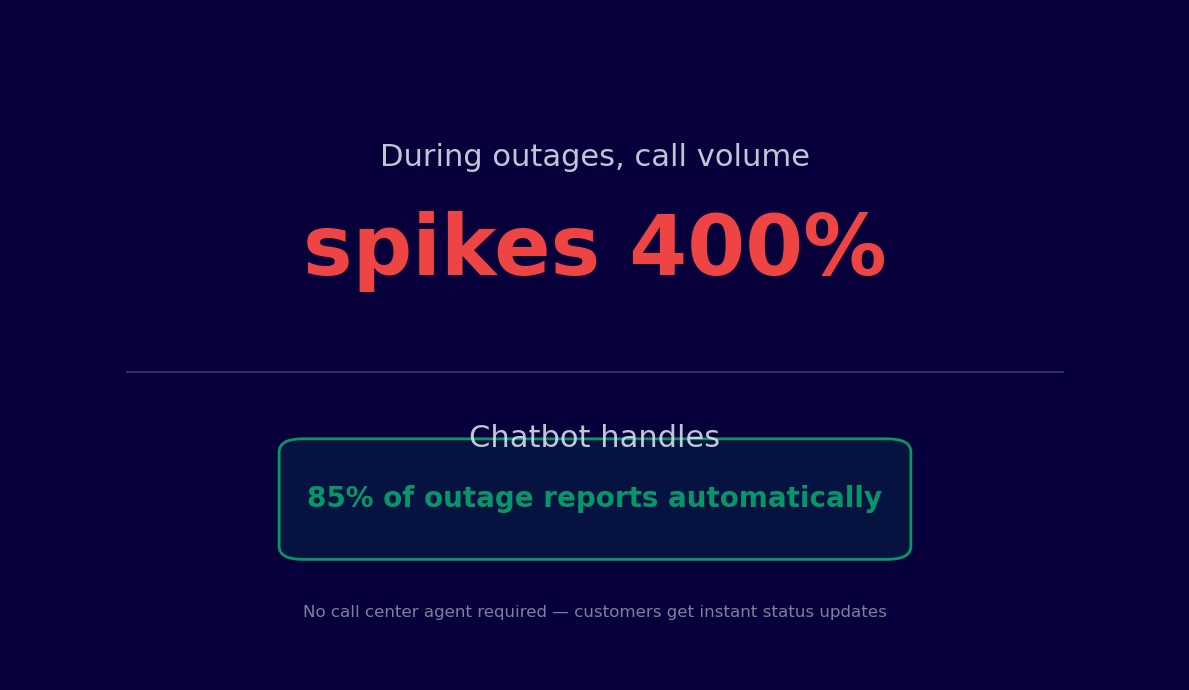
During major outage events, call volume can spike 10-20x above normal levels. A chatbot absorbs this spike entirely for status inquiry contacts, which represent the majority of outage-related calls. Utilities with chatbot outage self-service report that 50-70% of outage contacts during major events are resolved without agent involvement, preventing the call center from becoming inaccessible during the moments when customer trust is most at stake.
Payment and Collection Improvement
Easier payment access and streamlined payment arrangement processes reduce overdue account volume. Utilities report 10-20% reductions in past-due account rates after deploying chatbot payment tools, as the friction between wanting to pay and completing a payment is eliminated. Reduced bad debt directly improves financial performance and reduces collection costs.
Digital Channel Migration
Each contact resolved through a digital channel rather than the phone reduces cost and frees agent capacity. Chatbots accelerate the migration of customers to digital service channels. Utilities that deploy chatbots across their website and WhatsApp report accelerating their digital contact share by 15-25 percentage points, improving the long-term cost structure of their customer service operations.
| Metric | Impact |
|---|---|
| Overall call deflection | Up to 40% reduction in call volume |
| Billing contact deflection | 60%+ of billing calls resolved by chatbot |
| Outage status deflection | 50-70% during major events |
| Past-due account rate | 10-20% reduction |
| Digital channel share | +15-25 percentage points |
| Annual call center savings | $1M-$3M+ for large utilities |
Get Started with Energy and Utility Chatbots Today
Whether you are a large investor-owned utility, a municipal utility, a rural electric cooperative, or a competitive retail energy provider, Conferbot provides the tools to automate your highest-volume customer service interactions with AI chatbots.
Launch in 3 Steps
- Sign up for free at app.conferbot.com/signup -- no credit card required. Start with the free plan to build and test your first utility chatbot with 100 monthly conversations included.
- Build your utility bot using Conferbot's AI chatbot builder. Connect to your billing system, OMS, and scheduling platform via API integration for real-time data access.
- Deploy across channels -- Publish on your website and WhatsApp to serve customers on the channels they use most, with consistent service quality across every contact point.
Why Utility Companies Choose Conferbot
- No code required -- Customer service and operations teams deploy and maintain bots with the visual builder, with no IT dependency for day-to-day updates
- Billing system integration -- Real-time API connections to your billing, OMS, and scheduling systems ensure every interaction is based on current account data
- High-volume resilience -- Chatbot infrastructure scales automatically during outage events and billing peaks without degrading response quality
- Seamless agent escalation -- Complex issues connect to a live agent via live chat without the customer needing to repeat their issue
- Deflection analytics -- Comprehensive reporting on deflection rates, resolution rates, and customer satisfaction to demonstrate and optimize ROI
- Multi-channel service -- One platform covering website, WhatsApp, and more for consistent omnichannel service
Explore chatbot solutions for other industries: automotive, insurance, healthcare, real estate, e-commerce, hospitality, and HR.
Create your free energy and utility chatbot now and start deflecting call center volume in 2026.
Energy & Utilities FAQ
Everything you need to know about chatbots for energy & utilities.
Chatbots for Other Industries
Discover how businesses in other industries use AI chatbots to automate support, capture leads, and grow.
