
- Conferbot lets logistics companies automate 'Where is my shipment?' inquiries by connecting to tracking systems via webhooks for real-time status lookups.
- Collect quote requests with structured chatbot forms that capture origin, destination, cargo details, and timelines -- then push leads to your TMS or CRM automatically.
- Deploy on your website, WhatsApp, Messenger, and 8+ channels so customers and partners get instant answers wherever they reach out.
- Handle damage claims and delivery exceptions with file upload nodes that let customers submit photos, documents, and supporting evidence directly in the chat.
- Escalate complex issues to live agents with full conversation history, priority levels, and ticket management for seamless human handover.
Why Logistics Professionals Choose Conferbot
Reduce repetitive inquiry volume and give customers instant answers to their most common shipping questions -- even at 2 AM on a Sunday.
Connect with Your Logistics Stack
Connect your chatbot to your TMS, tracking systems, and business tools through webhooks and Zapier -- no custom development required.
Everything You Need for Logistics Automation
A complete chatbot toolkit for logistics companies to automate customer communication, streamline operations, and reduce support costs.
Shipment Inquiry Bot
Connect your tracking system via webhooks so the chatbot answers 'Where is my shipment?' questions instantly. Customers enter a tracking number and get real-time status pulled directly from your systems.
Quote Request Bot
Collect shipment details through structured chatbot forms -- origin, destination, cargo type, weight, dimensions, and timelines. Qualified leads are pushed to your TMS or CRM via webhooks and Zapier.
Delivery Scheduling
Let customers book or reschedule delivery windows using the built-in calendar booking node. Sync appointments to your dispatch system through webhooks for real-time scheduling.
Claims Collection Bot
Streamline the claims process with file upload nodes. Customers submit damage photos, invoices, and supporting documents directly in the chat, and your team receives everything with full conversation context.
Shipping FAQ & Policies
Build a knowledge base with your shipping rates, delivery zones, customs policies, and packaging guidelines. AI answers customer questions accurately from your own content using leading AI, Claude, and Gemini.
Live Support Handover
When a customer has a complex issue, lost shipment, or escalation, the chatbot hands off to a live agent with full context. Agents get priority levels, assignment routing, and internal notes.
Powered by leading AI models including GPT-4, Claude, and Gemini.
Get Started in Three Easy Steps
Deploy your chatbot in minutes, not months. No coding required.
Choose Your Template
Pick from pre-built shipment tracking, quote request, or claims collection templates -- or build custom flows from scratch with the visual drag-and-drop builder and 30+ node types.
Customize & Connect
Add your shipping policies to the knowledge base. Set up webhooks to pull tracking data from your TMS, and connect to your CRM and 5,000+ apps via Zapier.
Deploy & Monitor
Go live on your website, WhatsApp, Messenger, and more. Track inquiry volumes, resolution rates, and customer satisfaction with real-time analytics dashboards.
Trusted by Logistics Organizations Everywhere
From freight brokers to last-mile carriers, logistics businesses use Conferbot to handle customer inquiries at scale without growing their support team.
Why Logistics Needs AI Chatbots
Logistics operations run on time-sensitive information, and the gap between what customers need to know and what your team has capacity to communicate is where service failures happen. Industry research consistently finds that 70% of all inbound logistics customer queries are some variant of "where is my package" -- a question that is entirely automatable yet continues to consume enormous contact center capacity. In 2026, logistics providers that still route these queries to human agents are leaving measurable efficiency gains on the table while their customers wait on hold.
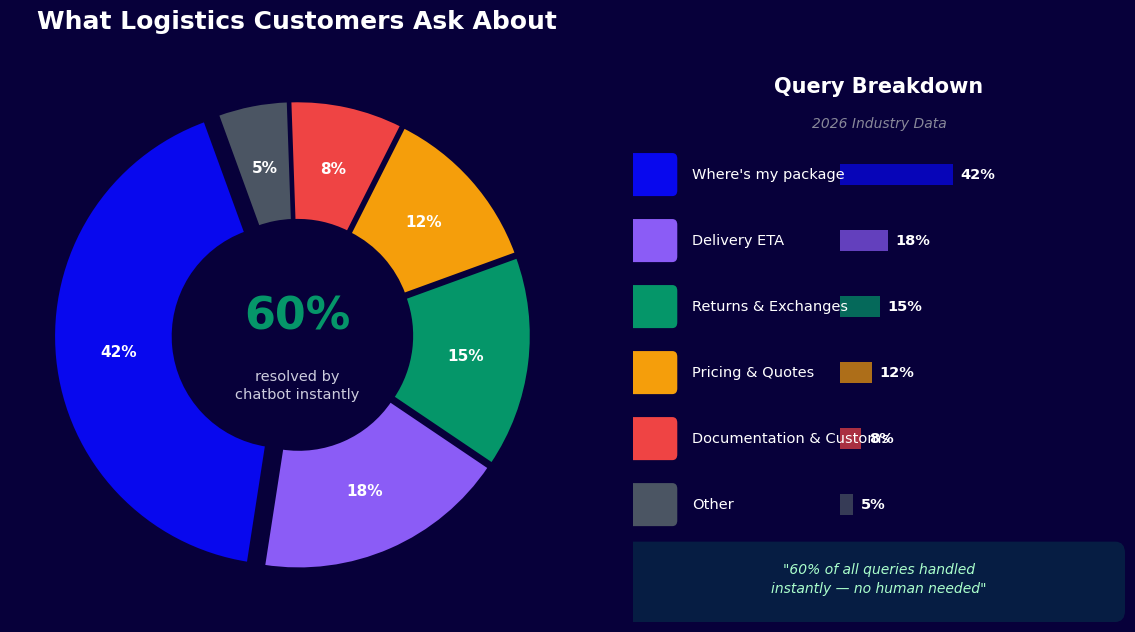
A logistics chatbot is an AI-powered conversational assistant deployed across your website, WhatsApp, and other customer channels that handles the relentless volume of routine inquiries your operations generate every day. Shipment status, estimated delivery windows, carrier details, customs clearance updates, proof of delivery, return initiation, and claims filing -- all available instantly, 24 hours a day, without a single agent interaction. For queries that genuinely require human judgment, the bot escalates with full context already captured, so your team spends their time solving problems rather than gathering data.
Logistics providers deploying chatbots report that chatbots deflect 65% of routine inquiries entirely, reducing contact center workload while simultaneously improving customer satisfaction scores through faster, more consistent responses. For freight brokers and 3PLs, the chatbot also serves as a front-end for carrier selection queries, rate comparisons, and capacity checks -- commercially valuable interactions that previously required agent time just to qualify.
Conferbot's no-code chatbot builder integrates with your TMS, WMS, and carrier APIs through our API integration layer, giving the chatbot access to real-time shipment data, inventory levels, and delivery statuses. Analytics track deflection rates, query categories, and customer satisfaction so you can continuously measure and improve the automated experience.
This guide covers the highest-impact chatbot use cases for logistics in 2026: shipment tracking, carrier selection, warehouse queries, last-mile updates, returns and claims, fleet communications, customs documentation, and proactive customer notifications.
Automating Shipment Tracking Inquiries
Shipment tracking is the single highest-volume interaction in logistics customer service, and it is also the most automatable. When a customer asks "where is my shipment," every piece of information they need already exists in your systems -- the chatbot's job is to surface it instantly through a conversational interface.
Real-Time Status Lookup
Integrated with your TMS or carrier tracking APIs, the chatbot accepts a tracking number, order reference, or even a customer name and retrieves the current shipment status in real time. It presents the information in plain language: carrier name, current location, last scan event, estimated delivery date, and any exceptions or delays. For customers tracking on WhatsApp, the bot can send formatted updates with interactive options to request more details, set delivery preferences, or report an issue.
Proactive Exception Management
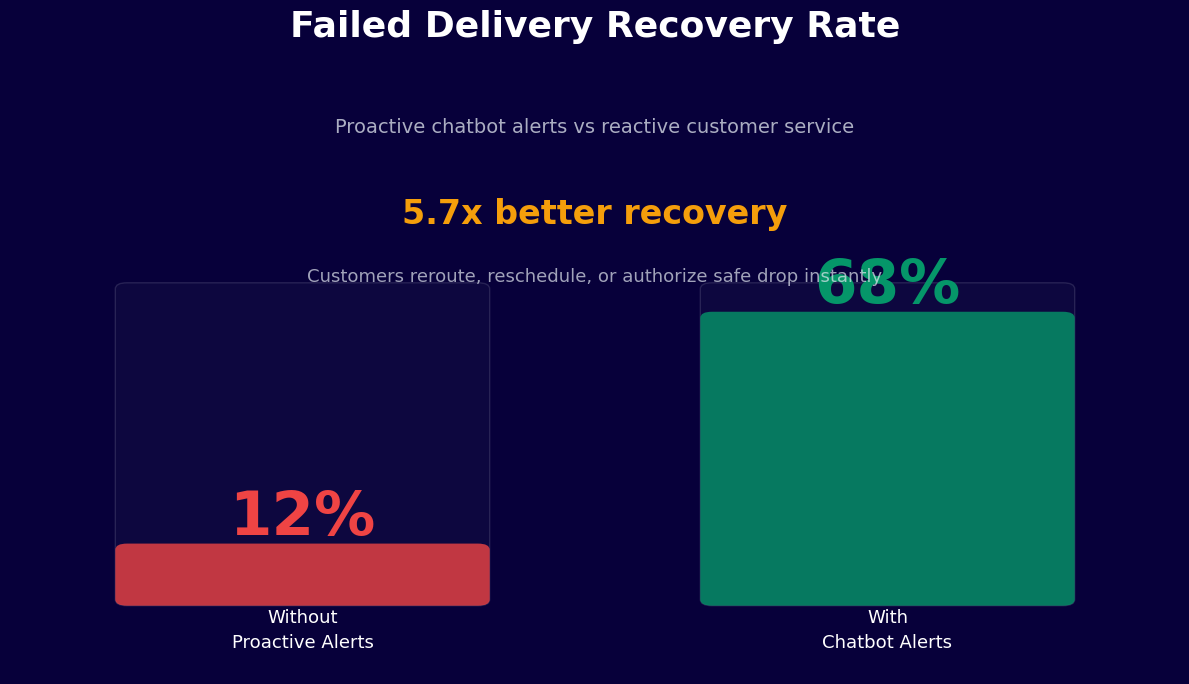
Rather than waiting for a customer to call about a delayed shipment, the chatbot monitors exception feeds from your TMS and proactively notifies affected customers through their preferred channel. A weather delay on a freight lane, a customs hold, a missed delivery attempt -- each exception triggers an automated customer notification with the reason, revised ETA, and available options. Proactive exception communication reduces inbound contacts from affected customers by 40-60% because customers who already know what is happening do not need to call and find out.
Multi-Carrier Visibility
Many shippers use multiple carriers and struggle to give customers a unified tracking experience. The chatbot abstracts carrier-level complexity: regardless of whether the shipment moved via your owned fleet, a national carrier, or a regional last-mile partner, the customer receives a consistent conversational experience with the same information depth. Through Conferbot's API integration, you connect to as many carrier tracking feeds as needed.
Proof of Delivery Retrieval
Accounts payable and procurement teams regularly request proof of delivery documents for billing reconciliation. The chatbot handles these requests without agent involvement: verify the requestor, retrieve the POD from your document management system, and deliver it as a downloadable link within the conversation. What was previously a 20-minute email chain becomes a 60-second automated interaction.
Carrier Selection and Warehouse Query Handling
Beyond customer-facing tracking, logistics chatbots deliver significant internal and operational value by handling carrier selection queries from shippers and routine warehouse information requests from staff and partners.
Automated Carrier Selection Guidance
Freight brokers and 3PLs field dozens of carrier selection inquiries daily. Shippers need to know: which carrier can handle a 20,000 lb LTL shipment from Chicago to Miami by Thursday? What is the rate differential between expedited and standard lanes? Are there capacity constraints on a specific corridor? A chatbot connected to your rate engine and capacity management system answers these questions instantly, presenting carrier options with rates, transit times, service levels, and capacity availability. Shippers make faster booking decisions, and your team handles more volume without adding headcount.
Rate Quote Automation
For standard freight lanes, the chatbot collects shipment parameters conversationally -- origin, destination, commodity, weight, dimensions, required delivery date -- and returns rate options across applicable carriers. This replaces the email rate request workflow that can take hours to resolve. High-confidence quotes are presented immediately; complex or oversized shipments are flagged for broker review with all parameters already captured, cutting the follow-up time significantly.

Warehouse Information Queries
Warehouse staff, carrier drivers, and freight partners need quick answers to operational questions: dock door assignments, appointment scheduling, inventory availability, receiving hours, and facility-specific handling requirements. An internal-facing chatbot deployed via your intranet or a WhatsApp group handles these queries without tying up your dock supervisor or operations team. Drivers checking in via WhatsApp can receive their dock assignment, unloading sequence, and facility rules automatically.
Inventory Visibility for Customer Service
3PL clients frequently need current inventory counts, lot information, or pallet location data to answer their own customer inquiries. A chatbot connected to your WMS gives client contacts self-service inventory visibility through secure, account-scoped queries. Clients get the information they need immediately; your account management team is freed from acting as a human middleware layer between clients and your WMS.
| Query Type | Traditional Handling | Chatbot Resolution Time |
|---|---|---|
| Shipment status | 5-10 min agent call | Under 30 seconds |
| Rate quote (standard) | 2-4 hours via email | Under 2 minutes |
| Dock assignment | Phone call to supervisor | Instant via WhatsApp |
| Inventory count | WMS log-in or email | Instant, account-scoped |
| POD retrieval | 15-20 min email chain | Under 60 seconds |
Last-Mile Delivery Updates and Customer Communication
Last-mile delivery is where the logistics industry is most visible to end consumers, and it is where service failures have the highest reputational cost. The chatbot layer between your last-mile operations and your customers transforms what is often a frustrating black box into a transparent, communicative experience.
Day-of-Delivery Notifications
On the morning of scheduled delivery, the chatbot sends automated notifications through the customer's preferred channel with the confirmed delivery window, driver name, and any preparation instructions (e.g., signature required, access code needed, refrigerated storage). Customers who are informed and prepared result in fewer failed first-attempt deliveries -- a metric that typically costs $15-25 per re-delivery attempt across the industry.
Dynamic Delivery Window Updates
Route optimization and real-time traffic data mean delivery windows shift throughout the day. The chatbot monitors your driver dispatch system and sends updated ETAs as the route progresses. When a driver is running ahead of or behind schedule by more than a defined threshold, affected customers receive an automatic update with the revised window and options to redirect, hold at a facility, or authorize a leave-safe instruction.
Delivery Attempt Communication
When a first delivery attempt fails -- no one home, locked gate, incorrect address -- the chatbot immediately contacts the recipient with the miss notification, reason, and options: reschedule for the next available window, redirect to a pickup location, provide a leave-safe authorization, or update the delivery address. Rapid automated communication after a miss reduces the re-delivery cycle by one to two days compared to manual outreach processes.
Delivery Confirmation and Feedback
Immediately following successful delivery, the chatbot sends a confirmation with delivery timestamp and, where available, a photo of the delivered package. A brief two-question satisfaction survey captures the delivery experience while the interaction is fresh. This real-time feedback identifies systemic issues with specific routes, drivers, or delivery windows before they become patterns. Analytics aggregate feedback data for operational review.
B2B Delivery Communication
Commercial deliveries to distribution centers, retail locations, or office buildings involve receiving departments with specific requirements. The chatbot communicates appointment confirmations, dock door assignments, unloading sequences, and required documentation to receiving managers in advance, reducing the coordination friction that causes costly driver detention time.
Returns Processing and Claims Management
Returns and damage claims are high-friction processes that consume disproportionate customer service resources. A chatbot streamlines both by guiding customers through structured intake processes and automating the routine decisions that do not require human judgment.
Return Initiation and Label Generation
When a customer or consignee needs to return a shipment, the chatbot handles the entire initiation process: verify the original shipment, confirm the return reason, collect condition information, and trigger the return authorization workflow in your TMS. For eligible returns, the bot generates and delivers a prepaid return label immediately within the conversation. This self-service return initiation reduces the cost per return transaction while improving the customer experience through speed and convenience.
Claims Filing for Damage and Loss
Filing a freight claim has historically been a manual, document-heavy process that discourages legitimate claims and frustrates customers. The chatbot provides a guided claims intake experience: identify the shipment, describe the damage or loss, collect photographic evidence, confirm declared value and supporting documentation, and submit the completed claim to your claims management system. The structured collection ensures claims arrive with all required information, reducing the adjudication cycle time significantly. Customers can also check claim status through the same chatbot without calling your claims department.
Claims Status and Communication
The most frequent call a claims department receives is "what is the status of my claim?" -- a question that is entirely automatable. The chatbot queries your claims system and provides real-time status updates: claim received, under review, documentation requested, approved, payment issued. Proactive milestone notifications mean affected customers stay informed without initiating contact, reducing inbound claims status calls by 50-70%.
Policy Communication and Dispute Resolution
Claims that do not meet filing requirements or exceed coverage limits require careful communication. The chatbot presents denial or adjustment explanations in clear, non-technical language, outlines the appeals process, and provides options for escalation to a claims specialist via live escalation. Consistent, well-explained communications reduce dispute escalation rates and protect the carrier relationship even in adverse outcomes.
Fleet Communication and Customs Documentation
Two high-complexity operational areas -- fleet management communication and customs documentation -- benefit significantly from chatbot-driven automation that reduces administrative overhead without sacrificing accuracy.
Fleet and Driver Communication
Dispatchers managing large fleets spend significant time fielding routine communications from drivers: load confirmations, delivery instructions, special handling requirements, customer contact information, and hours of service questions. A chatbot serving as a driver-facing communication interface on WhatsApp or a dedicated driver app handles these queries automatically, pulling load details from your TMS and delivery instructions from your order management system. Drivers get the information they need without tying up dispatcher bandwidth for questions the system can answer directly.
Load Confirmation and Documentation Delivery
Before pickup, the chatbot sends drivers a complete load packet: shipper address and contact, commodity and handling requirements, delivery window, consignee details, and required documentation (BOL, hazmat papers, temperature logs). The conversational delivery of this information reduces the incidence of drivers arriving at shippers without correct documentation -- an expensive and time-sensitive operational failure.
Customs Documentation Assistance
Cross-border shipments generate significant documentation complexity: commercial invoices, packing lists, certificates of origin, HS code classification, and import/export declarations. A chatbot trained on your commodity catalog and trade lane requirements guides shippers and operations teams through the documentation checklist for specific trade lanes, flags missing or incomplete items, and routes documentation packages to your customs brokerage workflow. While the chatbot does not replace a licensed customs broker, it dramatically reduces the back-and-forth that occurs when documentation is incomplete at the time of tender.
Regulatory and Compliance Queries
Operations teams handling international freight regularly encounter questions about country-specific import restrictions, packaging requirements, labeling standards, and duty rate estimates. A chatbot equipped with your trade lane knowledge base and connected to relevant customs databases answers these questions at the point of need, reducing the research burden on your international freight team and accelerating compliant shipment preparation.
Proactive Customer Notifications at Scale
The most powerful shift a logistics chatbot enables is from reactive customer service -- answering questions after customers call -- to proactive communication that prevents those calls from happening at all. When customers already know what they need to know, inbound contact volume drops dramatically.
Automated Shipment Milestone Notifications
Configure the chatbot to send notifications at each meaningful shipment milestone: order confirmed, shipment tendered to carrier, picked up, in transit, out for delivery, delivered, and exception detected. Each notification is sent through the customer's preferred channel -- website chat, WhatsApp, email, or SMS -- and includes the relevant details for that milestone. Customers who receive proactive milestone updates report significantly higher satisfaction scores and generate dramatically fewer inbound status inquiries.
SLA Risk and Delay Alerts
When a shipment is at risk of missing its committed delivery date due to weather, carrier capacity issues, or route delays, the chatbot identifies affected shipments through your TMS exception management feed and sends proactive alerts to customers before they discover the delay themselves. The notification includes the reason, revised ETA, and any remediation options (expedite upgrade, alternate carrier, pickup alternative). Customers who learn about delays proactively, before they affect their operations, respond far more constructively than those who call to find out their shipment is late.
Bulk Notification Campaigns
For network-wide events -- facility closures, holiday schedule changes, lane suspensions -- the chatbot enables bulk outreach to affected customers through Conferbot's broadcast capability. A single configured campaign notifies all impacted accounts through their registered channels with relevant information and customer service contacts. What would require hours of manual outreach is executed in minutes with consistent messaging.
Post-Delivery Engagement and Retention
Following successful delivery, the chatbot can send satisfaction surveys, solicit reviews, present upsell offers for additional services (insurance, expedited lanes, warehousing), and invite customers to enroll in automated tracking preferences. These post-delivery touchpoints generate both operational feedback and commercial opportunities with minimal incremental cost. Use Conferbot analytics to track response rates and identify which touchpoints drive the most downstream value.
ROI and Getting Started with Logistics Chatbots
The return on investment for logistics chatbots is among the most straightforward to calculate in any industry because the primary value driver -- inquiry deflection -- is directly measurable against a known cost per contact.
Contact Center Cost Reduction
If your logistics operation handles 40,000 customer contacts per month at an average cost of $8 per contact, a 65% deflection rate saves $208,000 per month in contact center operating costs. Even at more conservative deflection rates (40-50%), the financial case is compelling against a chatbot investment that scales without per-contact variable costs.
Failed Delivery Reduction
At $15-25 per failed delivery attempt, even a 20% reduction in first-attempt failure rates through proactive communication and dynamic ETAs generates significant savings. For an operation making 10,000 deliveries per week with a 15% failure rate, reducing failures to 12% saves $45,000-$75,000 weekly in re-delivery costs.
Claims Processing Efficiency
Automated claims intake with complete documentation reduces the average claims processing cycle and the cost of adjudication. Operations report 25-35% reduction in per-claim processing cost through structured chatbot-driven intake and self-service status communication.
Launch in 3 Steps
- Sign up for free at app.conferbot.com/signup -- no credit card required. The free plan includes website chatbot deployment and 100 monthly conversations to validate your use case.
- Build your logistics bot using Conferbot's visual builder. Start with a shipment tracking flow, connect your TMS or carrier APIs via API integration, and expand to carrier selection, returns, and proactive notifications as you validate results.
- Deploy across channels -- publish on your website and WhatsApp to meet customers where they already communicate. Use analytics to track deflection rate, query categories, and satisfaction from day one.
Why Logistics Operators Choose Conferbot
- API integration depth -- connect to TMS, WMS, and carrier APIs through our flexible integration layer
- No-code builder -- operations and CX teams configure flows without IT using the visual builder
- Multi-channel reach -- one bot across website, WhatsApp, and messaging for B2C and B2B customers
- AI-powered understanding -- handles the natural language variation in logistics queries without rigid keyword matching
- Deflection analytics -- track what percentage of queries are resolved without agent involvement
- Scalable pricing -- start free, grow with volume. Calculate your ROI before you commit
Explore chatbot solutions for related industries: e-commerce, insurance, and technology.
Create your free logistics chatbot now and start deflecting tracking inquiries on day one in 2026.
Logistics FAQ
Everything you need to know about chatbots for logistics.
Chatbots for Other Industries
Discover how businesses in other industries use AI chatbots to automate support, capture leads, and grow.
