9 Free Templates Available

Best Ecommerce and Retail Chatbot Templates

Get free, ready-to-use ecommerce and retail chatbot templates that help boost conversions and automate customer interactions. Start building in 2 minutes with no coding required.

100% Free
No Coding Required
Instant Deploy
🤖
67%
Higher Conversions
2min
Setup Time
24/7
Automated
9+
Templates

Explore Templates & Resources

Browse templates, learn about the category, or find answers to common questions

Categories22

Ecommerce And Retail Templates

Choose from our collection of proven ecommerce and retail chatbot templates

9templates
Sustainable Travel Planner - Ecommerce and Retail template preview

Sustainable Travel Planner

Plan your eco-friendly adventure with Conferbot’s Sustainable Travel Planner. Discover green accommodations, carbon-efficient travel options, and sustainable activities for an unforgettable, earth-friendly journey.

Ecommerce and Retail
8uses
2likes
Price Drop Alert System - Ecommerce and Retail template preview

Price Drop Alert System

Never miss a deal again with Conferbot’s Price Drop Alert System. Track your favorite products, receive instant notifications on price changes, and make smarter purchasing decisions effortlessly.

Ecommerce and Retail
10uses
1likes
Subscription Box Customizer - Ecommerce and Retail template preview

Subscription Box Customizer

Enhance customer satisfaction with Conferbot's Subscription Box Customizer. Offer personalized product selections, seamless customization, and 24/7 assistance to maximize engagement and retention.

Ecommerce and Retail
4uses
1likes
Sustainable Product Finder - Ecommerce and Retail template preview

Sustainable Product Finder

Discover eco-friendly products effortlessly with Conferbot's Sustainable Product Finder. Offering personalized recommendations, ethical sourcing insights, and 24/7 support, it helps you make sustainable choices for a greener future.

Ecommerce and Retail
1uses
1likes
Virtual Shopping Assistant - Ecommerce and Retail template preview

Virtual Shopping Assistant

Enhance your e-commerce experience with Conferbot’s Virtual Shopping Assistant. Deliver personalized product recommendations, real-time inventory updates, and seamless checkout processes to increase conversions and customer satisfaction.

Ecommerce and Retail
10uses
1likes
Inventory Checker - Ecommerce and Retail template preview

Inventory Checker

Keep your inventory in check with Conferbot's Inventory Checker. Ensure real-time stock updates, streamline inventory management, and reduce human error with 24/7 monitoring and alerts.

Ecommerce and Retail
10uses
1likes
Product Customization Guide - Ecommerce and Retail template preview

Product Customization Guide

Elevate your customer experience with Conferbot's Product Customization Guide. Provide real-time personalization options, streamline the customization process, and offer 24/7 support for tailored product choices.

Ecommerce and Retail
3uses
1likes
Flash Sale Notifier - Ecommerce and Retail template preview

Flash Sale Notifier

Maximize your sales and customer engagement with Conferbot’s Flash Sale Notifier. Deliver instant notifications, personalized discounts, and real-time updates to drive urgency and boost conversions.

Ecommerce and Retail
2uses
1likes
Loyalty Program Explainer - Ecommerce and Retail template preview

Loyalty Program Explainer

Elevate customer retention with Conferbot's Loyalty Program Explainer. Easily explain membership perks, track rewards, and boost engagement with personalized incentives that drive repeat business.

Ecommerce and Retail
6uses
1likes
Page 1 of 2

Unified Commerce: Bridging Online and In-Store With Chatbots

The line between e-commerce and brick-and-mortar retail has dissolved. Today's consumers shop across channels — browsing online, checking store inventory on their phone, buying in-app, returning in-store, and expecting consistent service throughout. Retailers that deliver a unified commerce experience through chatbot automation see 30% higher customer lifetime value and 25% better retention compared to channel-siloed competitors.

The Omnichannel Customer Journey

A typical modern retail journey might look like this: a customer discovers a product on Instagram, asks the chatbot about sizing via DM, visits the store to try it on, decides to think about it, gets a WhatsApp reminder from the bot two days later, and completes the purchase online. If the bot treats each of these as separate interactions, the experience feels disjointed. Unified commerce chatbots track the full journey and maintain context across every touchpoint.

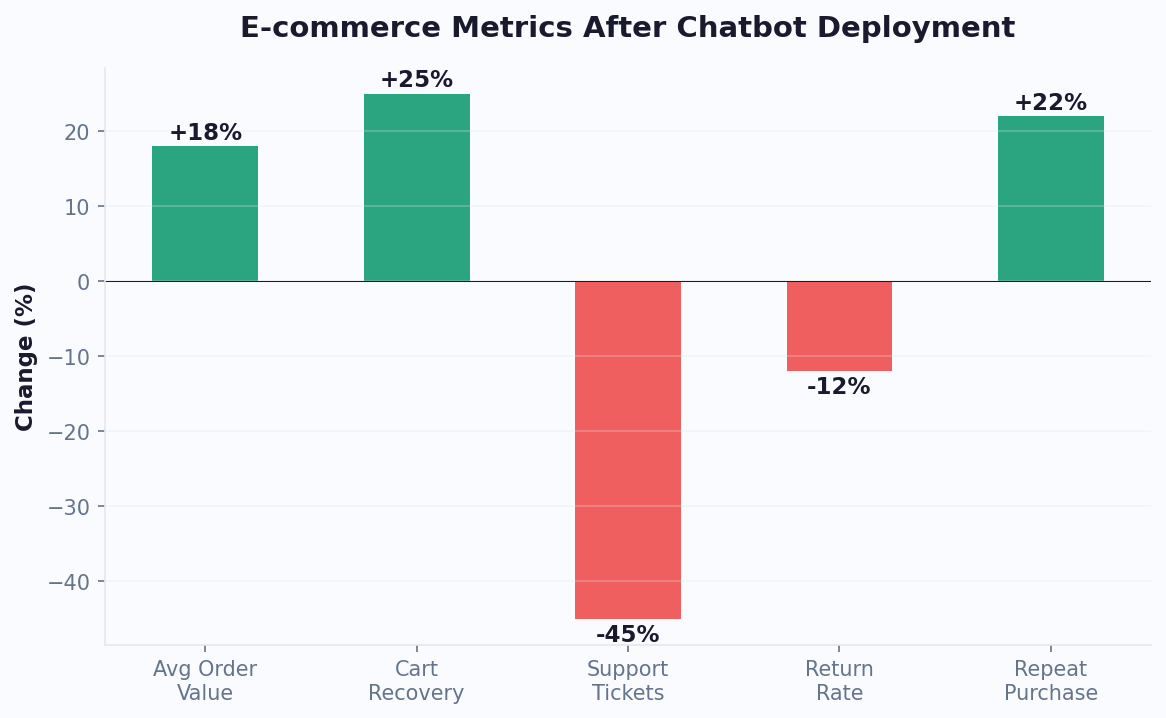
E-commerce and retail chatbot impact on key performance metrics

Online + In-Store Chatbot Functions

FunctionOnline ChannelIn-Store ChannelUnified Benefit
Product discoveryWebsite chatbot recommendationsQR code on shelf opens chatbotSame personalization engine powers both
Inventory check"Is this in stock?" with real-time API"Do you have this in size 10?"Single inventory source of truth
Purchase assistanceCart management, checkoutMobile self-checkout via chatbotCart persists across channels
Post-purchase supportOrder tracking, returnsReceipt lookup, exchange helpOne customer profile, all transactions
Loyalty programPoints balance, reward redemptionScan to earn, in-store offersPoints earned anywhere, redeemed anywhere

Implementation Strategy

  • Phase 1: Deploy the chatbot on your website and primary social channels with product search, recommendations, and cart recovery. This captures the majority of online interactions.
  • Phase 2: Add in-store touchpoints — QR codes on shelving, product tags, and at checkout. These link to the same chatbot with location-aware context.
  • Phase 3: Unify customer profiles across channels via CRM integration so that every interaction, whether online or in-store, builds a single customer view.

Explore our e-commerce chatbot templates to start building your unified commerce experience today.

Cart Recovery + In-Store Rescue: Capturing Every Abandoned Sale

Abandoned sales happen everywhere — not just in online shopping carts. In physical retail, customers browse, try on items, and leave without buying at alarming rates. The average brick-and-mortar conversion rate is 20-40%, meaning 60-80% of people who enter your store leave empty-handed. Chatbot-driven engagement addresses both online cart abandonment and in-store browse abandonment with a unified recovery strategy.

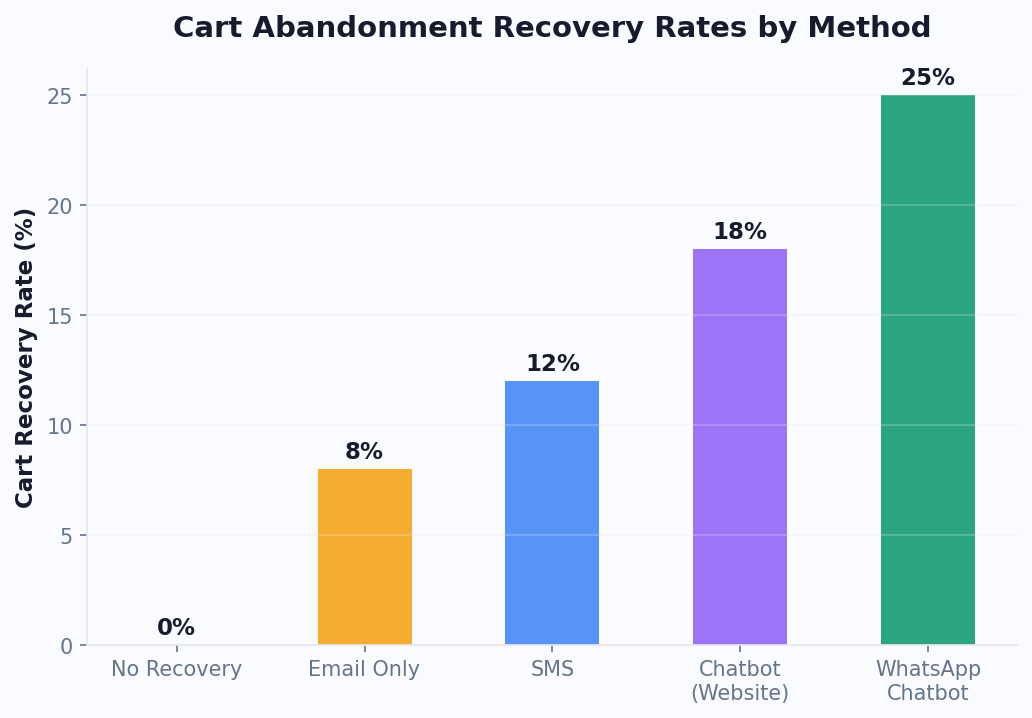
Cart and sale recovery rates across online and retail channels

Online Cart Recovery Tactics

TacticRecovery RateTimingChannel
Exit-intent chatbot popup12-18%At moment of exitWebsite
WhatsApp abandoned cart message18-28%30-60 min afterWhatsApp
SMS cart reminder10-15%2-4 hours afterSMS
Email recovery sequence5-8%1-72 hours afterEmail
Retargeting ad with chatbot CTA4-7%1-7 days afterSocial / Display

In-Store Browse Abandonment

Capturing in-store abandonment requires a different approach since you often do not have the customer's contact information. Here are proven strategies:

  • WiFi capture: Offer free in-store WiFi in exchange for email or phone number. Once captured, the chatbot can follow up: "Thanks for visiting today! I noticed you spent time in our denim section. Here's our new arrivals collection — anything catch your eye?"
  • Fitting room engagement: A QR code in the fitting room opens a chatbot: "Need a different size or color? I can have an associate bring it to you." This also captures contact info and browsing interest for follow-up.
  • Loyalty app integration: Members who scan their loyalty card in-store but do not purchase receive personalized follow-ups based on what they browsed. "The jacket you tried on is now 20% off this weekend!"

Combined Recovery Impact

Retailers implementing both online and in-store recovery through a unified chatbot system report 15-25% higher total sales recovery compared to online-only approaches. The key is a single customer profile that tracks behavior across all channels — when a customer browses in-store and later visits your website, the chatbot can reference their in-store activity to personalize the online experience. Build your recovery flows with our e-commerce and retail chatbot templates.

Product Recommendations: The Chatbot as Your Best Sales Associate

The best sales associates in retail possess an uncanny ability to read customers and suggest exactly the right products. They remember preferences, understand occasions, and know which items complement each other. A well-trained chatbot replicates this skill at scale — serving every customer simultaneously with personalized recommendations that drive measurable increases in average order value, items per transaction, and customer satisfaction.

Recommendation Performance by Strategy

Recommendation StrategyAOV IncreaseConversion LiftBest Use Case
Guided quiz / style finder+22%+35%Fashion, beauty, gifts
Complementary items ("Goes with")+18%+15%Apparel, home decor, electronics
Frequently bought together+14%+12%Grocery, health, consumables
Browsing-based suggestions+11%+20%General retail, marketplace
Replenishment reminders+8%+28%Consumables, subscriptions

The Conversational Advantage

Traditional website recommendation widgets display products passively — "You might also like..." — and achieve click-through rates of 2-5%. A chatbot recommendation is conversational and contextual, achieving engagement rates of 25-40%. The difference comes from dialogue:

  • Widget: Shows four related products. Customer ignores them or feels overwhelmed.
  • Chatbot: "I see you're looking at running shoes. What kind of running do you do — road, trail, or treadmill?" Based on the answer, it narrows to three options with explanations: "For trail running on rocky terrain, the CloudVenture has the best grip and ankle support. It's our #1 seller for trail runners."

This guided approach mirrors the in-store associate experience. Customers feel understood, make confident decisions, and are less likely to return the product — reducing return rates by up to 30% compared to unassisted purchases.

Personalization Data Sources

The chatbot draws on multiple data sources to personalize recommendations:

  • Current browsing session (pages viewed, time spent, items saved)
  • Historical purchase data (previous orders, frequency, preferences)
  • Conversational inputs (stated needs, budget, occasion)
  • Contextual signals (weather, location, trending items, seasonal relevance)

Configure your recommendation engine through Conferbot's product catalog integration and explore our product recommendation playbook for advanced personalization strategies.


Omnichannel Retail Strategy: Consistent Experiences Across Every Touchpoint

Omnichannel retail is not just about being present on multiple channels — it is about delivering a consistent, connected experience across all of them. Customers who shop across three or more channels spend 250% more than single-channel shoppers, making omnichannel strategy the highest-leverage investment in retail. A chatbot serves as the connective tissue, maintaining a unified conversation regardless of where the customer chooses to engage.

Channel Ecosystem for Modern Retail

ChannelPrimary RoleChatbot Function% of Interactions
WebsiteProduct discovery, purchaseRecommendations, cart, support35%
WhatsAppRe-engagement, serviceOrder updates, recovery, promos22%
Instagram DMDiscovery, social commerceProduct Q&A, shop from feed15%
Facebook MessengerAds, retargetingClick-to-chat from ads, support10%
In-store (QR / kiosk)Assisted selling, inventorySize check, alternatives, loyalty12%
SMSUrgency, time-sensitiveFlash sales, delivery alerts6%

The Consistency Imperative

Consistency means three things in omnichannel retail:

  • Knowledge consistency: The chatbot provides the same accurate information on every channel. A price, promotion, or policy should never differ between your website bot and your WhatsApp bot.
  • Context continuity: A customer who starts a conversation on Instagram and continues on your website should not have to repeat themselves. The chatbot recognizes them and picks up where they left off.
  • Experience parity: The chatbot should feel equally capable on every channel. WhatsApp should not be "the one where you can check orders" while the website is "the one where you get recommendations." All functions should be available everywhere, adapted to each channel's interface strengths.

Building the Omnichannel Stack

Conferbot's integration layer connects your chatbot to all major retail channels through a single configuration. Build your flows once, deploy everywhere, and manage from one dashboard. Customer profiles are automatically unified across channels using email, phone number, or loyalty ID as the matching key. For a step-by-step implementation guide, read our omnichannel chatbot strategy playbook.

To compare Conferbot's omnichannel capabilities against other platforms, visit our comparison page.

Retail Chatbot Metrics: KPIs That Drive Store and Online Growth

Retail chatbot success requires tracking metrics that span both digital and physical commerce. Unlike pure e-commerce, retail chatbot KPIs must account for cross-channel influence, in-store impact, and the complex attribution of omnichannel customer behavior. Here are the metrics that matter most and the benchmarks you should target.

Core Retail Chatbot KPIs

KPIDefinitionBenchmarkMeasurement
Chatbot-influenced revenueTotal revenue from sessions with chatbot interaction15-30% of total revenueSession attribution via analytics
Cart recovery rate% of abandoned carts recovered via chatbot15-25%Recovery events / abandonment events
Average order value (bot-assisted)AOV for orders with chatbot interaction15-25% above baselineCompare bot-assisted vs unassisted AOV
Cross-sell / upsell rate% of chatbot conversations that generate add-on sales20-35%Add-to-cart events during bot session
Support deflection rate% of support inquiries resolved without agent55-70%Bot resolutions / total support conversations
BOPIS conversionBuy-online-pickup-in-store orders via bot8-15% of online ordersBOPIS orders with bot attribution

Advanced Attribution Metrics

Simple last-click attribution undervalues the chatbot's contribution. A customer who engages with the bot on Monday, browses independently on Tuesday, and purchases on Wednesday would not show up in last-click attribution — yet the chatbot initiated and nurtured the journey. Use these advanced metrics for a fuller picture:

  • First-touch attribution: Revenue from customers whose first interaction was with the chatbot. This measures the bot's ability to capture and convert new visitors.
  • Multi-touch attribution: Distribute revenue credit across all touchpoints proportionally. If a customer had three interactions before purchase (chatbot, email, website), each receives one-third credit.
  • Incremental lift: Compare conversion rates for chatbot-engaged visitors versus non-engaged visitors with similar profiles. The difference is the chatbot's incremental contribution.

Reporting Cadence

Review chatbot metrics weekly for operational adjustments (unmatched queries, flow drop-offs) and monthly for strategic decisions (channel allocation, feature investment). Quarterly, present a comprehensive ROI report to leadership. Conferbot's analytics dashboard supports all these cadences with automated reports and scheduled email summaries. For advanced analytics configuration, consult our retail chatbot analytics guide.

Loyalty Program Engagement: Using Chatbots to Drive Repeat Purchases

Loyalty programs are a cornerstone of retail strategy, but participation rates tell a sobering story: the average consumer belongs to 16.7 loyalty programs but is active in only 7.6 of them. That means over half of all loyalty memberships are effectively dormant. A chatbot breathes life into loyalty programs by making engagement effortless — checking points, redeeming rewards, and earning bonuses all happen within natural conversations that customers are already having.

Loyalty Chatbot Impact

MetricWithout ChatbotWith ChatbotImprovement
Loyalty program active rate45%72%+60%
Average points redeemed/quarter2,1003,800+81%
Repeat purchase frequency2.4x/year3.8x/year+58%
Loyalty member AOV$73$91+25%
Program enrollment rate12%28%+133%

Chatbot-Driven Loyalty Interactions

  • Points balance check: "You have 4,200 points — that's enough for a $20 reward! Would you like to redeem it on your next purchase?" This simple interaction reminds customers of unredeemed value and drives transactions.
  • Earn notifications: "You just earned 150 points on your purchase! You're 300 points away from Gold status. Here's a bonus offer: earn double points this weekend." Real-time earning notifications create a gamification loop that sustains engagement.
  • Personalized rewards: Instead of generic rewards, the chatbot offers options aligned with purchase history. "Based on your coffee purchases, would you prefer a free latte or a $5 off pastries coupon?" Personalized rewards feel more valuable and drive higher redemption.
  • Birthday and milestone celebrations: "Happy birthday, Sarah! Here's a special 25% off coupon just for you — valid this week." Personal touches via chatbot feel thoughtful without requiring manual staff effort.
  • Tier progression prompts: "You're only $50 away from Platinum status! Platinum members get free shipping on every order. Want to see what's new?" Creating urgency around tier thresholds drives incremental spending.

Enrollment Optimization

The chatbot doubles as a loyalty enrollment tool. During any purchase interaction — product recommendation, checkout, or support — the bot can offer enrollment: "By the way, joining our rewards program gives you 10% off today and earns points on every purchase. Want to sign up? It takes 10 seconds." This contextual enrollment achieves 2-3x higher sign-up rates than static website banners. Connect your loyalty platform via Conferbot's integration hub and start driving engagement with our retail chatbot templates.

FAQ

Ecommerce And Retail Templates FAQ

Everything you need to know about chatbots for ecommerce and retail templates.

🔍
Popular:

Chatbots use exit-intent triggers on website and WhatsApp follow-ups to re-engage shoppers who abandon carts. They address the specific reason for abandonment — shipping costs, sizing doubts, payment concerns — and offer solutions in real time. Combined, these methods recover 18-30% of abandoned carts versus 5-8% for email alone.

Yes. The chatbot asks about occasion, budget, style, and recipient, then presents curated product suggestions from your catalog. Conversational product discovery achieves 35-45% higher engagement than static recommendation widgets because customers actively shape the results through natural dialogue.

Yes. Conferbot deploys across website, mobile app, WhatsApp, Instagram, and in-store QR codes with unified conversation history. A customer can start browsing products on your website and complete the purchase on WhatsApp. Omnichannel chatbot users spend 30% more per transaction than single-channel shoppers.

Conferbot's ecommerce and retail templates are free to start. Paid plans with product catalog sync, cart recovery, and omnichannel deployment start at $29/month. Enterprise plans for retail chains with POS integration, multi-store inventory, and unlimited conversations start at $149/month.

The chatbot verifies the purchase, checks return policy eligibility, generates prepaid return labels, and initiates refunds or exchanges automatically. Automated return handling reduces customer effort from 10-15 minutes to under 3 minutes and cuts return-related support costs by 55-65%.

Yes. The chatbot checks point balances, explains rewards, processes redemptions, and alerts members to bonus earning opportunities. Conversational loyalty engagement increases active participation by 25-35% and drives 15% higher repeat purchase rates compared to email-only loyalty communications.

Yes. The bot connects to your inventory system to show stock availability by size, color, and location. Customers check if items are available at their nearest store or for online delivery. Real-time inventory access reduces 'item unavailable' frustration and increases conversion by 15-20%.

The chatbot learns customer preferences over time — style, size, budget, brand affinities — and proactively suggests new arrivals, restocked favorites, and complementary items. Personal shopping chatbot users show 40% higher average order values and 2x purchase frequency versus self-browsing customers.

Yes. WhatsApp commerce chatbots let customers browse your catalog, add items to cart, and complete purchases entirely within WhatsApp. Product images, descriptions, and payment links are shared conversationally. Brands using WhatsApp commerce see 45-60% higher engagement than website-only shopping experiences.

Retailers typically see 5-10x ROI within 60 days. Cart recovery alone generates $8,000-$15,000 monthly for a store with 10,000 visitors. Add automated returns savings, product recommendation upsells, and support deflection, and the total annual impact reaches $50,000-$200,000 for mid-size retailers.

How to Use Ecommerce and Retail Chatbot Templates

Follow these simple steps to get your ecommerce and retail chatbot up and running in minutes

🎯

1. Choose Your Template

Select from high-converting lead generation templates designed for your industry and use case.

📋

2. Customize Qualifying Questions

Modify questions to match your ideal customer profile and lead scoring criteria.

🔄

3. Set Up Lead Routing

Configure automatic lead distribution to your sales team based on qualification scores.

🔗

4. Integrate with Your CRM

Connect to HubSpot, Salesforce, or your preferred CRM for seamless lead management.

📊

5. Deploy and Monitor

Launch your chatbot and track conversion rates, lead quality, and ROI through our analytics dashboard.

Why Choose Our Ecommerce and Retail Templates?

Compare the benefits of using professional templates vs. building from scratch

With Conferbot Templates

  • Deploy in 10 minutes
  • Proven conversion patterns
  • Industry best practices included
  • Ready-made integrations
  • Continuous updates & improvements
  • 24/7 expert support
  • Free to start

Building From Scratch

  • Weeks or months to develop
  • Trial and error approach
  • No proven patterns
  • Complex integration setup
  • Ongoing maintenance burden
  • Limited support resources
  • High development costs

Ready to Transform Your Ecommerce and Retail?

Join thousands of businesses using our ecommerce and retail templates to automate conversations and boost results